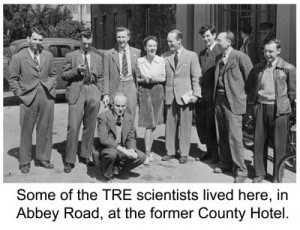
 The country’s Telecommunications and Radar Establishment (TRE) came to Malvern in May 1942. It was responsible for radar for the RAF (ground and airborne) and for the Fleet Air Arm. Most of the scientists who came with TRE were fit, young, clever men and women. They lived either in a large former hotel in the centre of Malvern, or were billeted with families.
Two thousand scientists and their families had to be accommodated in Malvern virtually overnight. Local houses were inspected for spare bedrooms and hostels for the WAAF were opened in places like St Ann’s Orchard. Huts were erected near to the main bases and hostel accommodation, to include a canteen, theatre and washrooms, was built in Geraldine Road. For a while the Winter Gardens were converted into a canteen serving 1,500 meals three time a day! Secrecy had to be maintained at all times despite so many radar operatives living and working among the civilian population.
It was only after 1945 that local people learned just how valuable their work had been in winning the war.
Courtesy https://malvernmuseum.co.uk/tre/
You can either Join us
Or if you are a member you can upload your information here >
The country’s Telecommunications and Radar Establishment (TRE) came to Malvern in May 1942. It was responsible for radar for the RAF (ground and airborne) and for the Fleet Air Arm. Most of the scientists who came with TRE were fit, young, clever men and women. They lived either in a large former hotel in the centre of Malvern, or were billeted with families.Two thousand scientists and their families had to be accommodated in Malvern virtually overnight. Local houses were inspected for spare bedrooms and hostels for the WAAF were opened in places like St Ann’s Orchard. Huts were erected near to the main bases and hostel accommodation, to include a canteen, theatre and washrooms, was built in Geraldine Road. For a while the Winter Gardens were converted into a canteen serving 1,500 meals three time a day! Secrecy had to be maintained at all times despite so many radar operatives living and working among the civilian population.
It was only after 1945 that local people learned just how valuable their work had been in winning the war.
Courtesy https://malvernmuseum.co.uk/tre/
You can either Join us
Or if you are a member you can upload your information here >
 `Radar Families'